
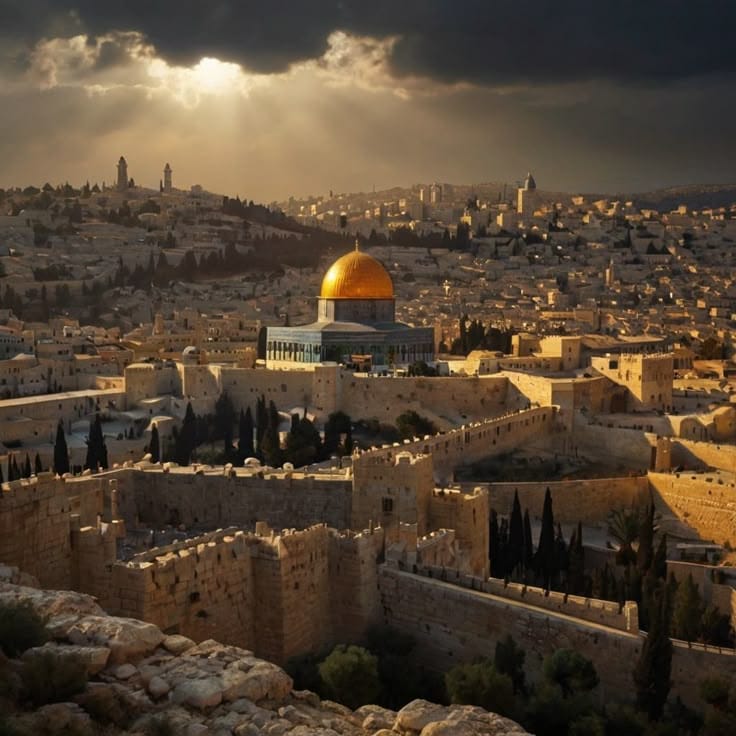
Jerusalem, perched on a limestone plateau in the Judean Mountains, is more than a city. It is sacred, symbolic and soaked in centuries of faith and blood. For over 3,000 years it has stood at the intersection of divine revelation and human conflict, where prophets once walked and empires once clashed for Jews, Christians, and Muslims alike Jerusalem is a spiritual epicentre, but this shared reverence has never meant peace.
Jerusalem and Judaism: The Eternal Capital
Jerusalem is the heart of Jewish identity around 1000 BCE King David established it as the capital of the Jewish kingdom. His son, King Solomon built the First Temple the dwelling place of God and the holiest site in Judaism. Babylonians destroyed it in 586 BCE, leading to exile and longing that would shape Jewish faith. The Second Temple, completed in 516 BCE and later renovated by Herod, was the center of Jewish worship until the Romans destroyed it in 70 CE. Today, The Western Wall, a remnant of that temple remains the most sacred site where Jews pray.
The Jewish connection to Jerusalem has never wavered, even through diaspora. The phrase “Next year in Jerusalem” became a symbol of enduring hope for return.
Jerusalem and Christianity: The City of Crucifixion and Resurrection
For Christians, Jerusalem is the city where salvation unfolded. Jesus of Nazareth preached, was crucified, buried, and resurrected here around 30 CE. The Church of the Holy Sepulchre, built in the 4th century under Emperor Constantine, marks the sites of his crucifixion (Golgotha) and resurrection.
Christianity spread under Roman rule, and Jerusalem became a pilgrimage destination. The city’s control shifted between Christian and Muslim rulers during the Crusades, when Europe launched brutal holy wars to retake it from Islamic empires.
To this day, Jerusalem remains a sacred destination for billions of Christians, a city of faith, miracles, and martyrdom.
Jerusalem and Islam: The City of the Night Journey
For Muslims, Jerusalem is the third holiest city after Mecca and Medina. In Islamic tradition, the Prophet Muhammad is believed to have ascended to heaven from Al-Aqsa Mosque during the Isra and Mi’raj , the miraculous Night Journey. The Dome of the Rock, built in 691 CE, stands where Muhammad is believed to have ascended. Al-Aqsa Mosque became a powerful symbol of Islamic civilization and spiritual heritage.
The Dome of the Rock, built in 691 CE, stands where Muhammad is believed to have ascended. Al-Aqsa Mosque became a powerful symbol of Islamic civilization and spiritual heritage.
Under Islamic caliphates, especially during the Umayyad and Abbasid eras, Jerusalem was treated with reverence and developed as a religious and cultural hub. Muslims ruled it for centuries except during the Crusades and a brief British mandate period until modern conflicts reignited the fire.
The Modern Battle: Politics, Religion, and Identity
In the 20th century, Jerusalem became the epicentre of the Israeli-Palestinian conflict. After the creation of Israel in 1948 west Jerusalem came under Israeli control while East Jerusalem including the Old City was under Jordan until 1967. During the Six-Day War, Israel captured East Jerusalem and declared the entire city its “eternal and indivisible capital.”
Palestinians however, claim East Jerusalem as the capital of a future Palestinian state. The city’s status remains one of the most contentious issues in peace negotiations. Clashes over access to holy sites especially Al-Aqsa often spark deadly violence.
Conclusion: One City, Three Faiths, Endless Conflict
Jerusalem is sacred to all and claimed by each. It holds dreams and prayers whispered across centuries yet its stones echo with war cries as often as with hymns. Can a city so holy be shared? Or is it destined to remain a battleground of belief?
Until faith finds a path to coexistence, Jerusalem will continue to be a mirror of humanity’s greatest hopes and deepest divides a holy city caught between heaven and history.