
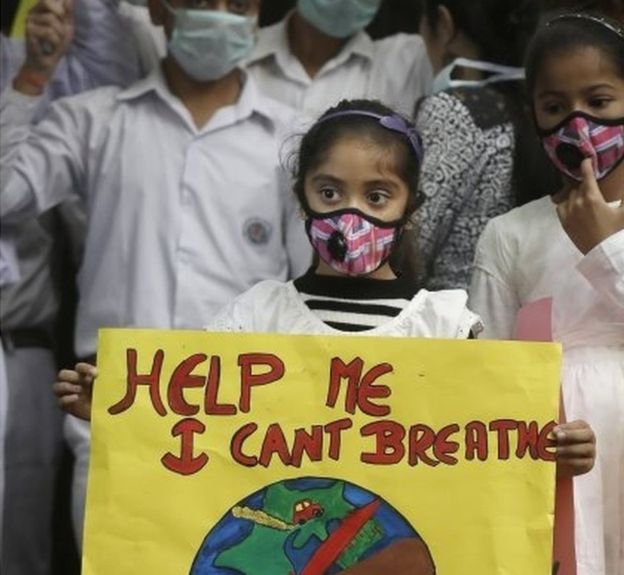
My eyes are burning as I write this, not from tears, not from screen glare, from the air I have no choice but to breathe. My throat, once used to delivering presentations and having conversations, has become a scratchy reminder of what it means to live in Delhi in November 2025. The pulmonologist’s advice echoes in my head “Stay indoors, Keep the air purifiers running, Avoid going out.”
But here’s the problem. The government doesn’t think this is a health emergency.
College is on, office expects me at my desk, and outside my window, the Air Quality Index reads a number that shouldn’t exist in a city meant for human habitation,1000.
The Numbers Don’t Lie, Even When They’re Manipulated
Let me give you some context. The World Health Organization considers any AQI above 50 unhealthy. Delhi right now? The official AQI hovers around 415 in the hazardous category, with readings that peaked at 503 just yesterday morning. But those are the official numbers, the ones the government is willing to admit.
Many suspect the real levels are much higher, with allegations that the government is manipulating and suppressing actual figures to avoid accountability. When your air purifier’s sensor shows triple the official reading, when your own lungs feel the difference between data and reality, you start to understand that this isn’t just bad. It’s catastrophic.
Delhi has been identified as the most polluted among Indian states and territories, with PM2.5 concentrations at 101 micrograms per cubic meter, twenty times above WHO guidelines. Twenty times! Let that sink in while you take your next breath.
My Family’s Silent Battle
My family members suffer from allergic asthma. What that means in practical terms is this: every breath during pollution season is a negotiation with their bodies. Will the airways stay open? Will the medication work today? Will we need to rush to the hospital at 2 AM again?
The burning eyes I mentioned earlier? That’s the least of it. My throat feels like I’ve swallowed sandpaper. There’s a persistent heaviness in my chest that wasn’t there in September. I’m 20, in college, interning, and supposedly in the prime of health. Or at least I was before this season started.
Doctors from AIIMS warn that pollution is now causing multi-system health damage, with cases of wheezing, persistent cough, chest tightness, and breathlessness affecting people who were previously healthy. That’s me. That’s my neighbors. That’s the colleague who’s been coughing through every Zoom call. This isn’t an abstract environmental issue discussed in seminars. This is our daily reality, measured in breaths that hurt and medicines we can’t afford to run out of.
The Cruel Arithmetic of Survival
The pulmonologist told us to stay home with air purifiers running 24/7. Sound advice, except:
A decent air purifier costs ₹15,000 to ₹40,000, replacement filters run ₹3,000 to ₹5,000 every few months, and the yearly cost of air purifiers, filters, and N95 masks adds another ₹10,000 to ₹15,000 annually. And that’s before you factor in the medical costs. A single pollution-triggered hospitalization in a private hospital can cost ₹35,000 to ₹80,000, not counting follow-up medications and nebulizers.
We’re being asked to individually purchase clean air, a basic necessity for survival, while the systems that should protect us treat this as just another winter inconvenience.
Not a Season, A Pandemic
Delhi’s air pollution has become an annual public health catastrophe, as lethal as the COVID-19 pandemic, if not worse. Yet where are the emergency measures? Where is the crisis response?
During COVID-19, we saw lockdowns within days. Schools shut, offices closed, the entire machinery of the state mobilized to protect public health. But now? In 2025, zero percent of 327 days were within WHO’s safe air quality limits. Zero. Not a single day of safe air. And still, we’re told to attend college, show up for internships, carry on as normal.
The disconnect is staggering. Hundreds of people, including children and activists, protested at India Gate, but faced police repression as authorities declared their gathering illegal and detained many protesters. We’re not even allowed to collectively demand the air we need to survive.
The Government’s Theatrical Response
What has the government done? Officials installed anti-smog guns on high-rise buildings and deployed water sprinklers for dust mitigation. They tried cloud seeding three times. All three attempts failed because there wasn’t enough moisture in the atmosphere.
These are not solutions, They’re theater. Expensive, scientifically questionable theater designed to look like action while avoiding the hard decisions that might actually work.
The government has now ordered 50% of employees in government and private offices to work from home under GRAP Stage III. A good step, but it came after weeks of severe pollution, after thousands had already been hospitalized, after children’s lungs had already been damaged.
Meanwhile, PM2.5 levels in Delhi reached 438 micrograms per cubic meter, 30 times higher than WHO’s safe limit and eight times the Indian national average. These particles don’t just irritate, they clog lungs, cause chronic respiratory diseases, permanent damage, and even cancer.
What Pollution Actually Does to Your Body
Let me tell you what the research shows, because the government certainly isn’t spelling this out clearly:
Delhi’s smog is now damaging hearts, kidneys, fertility, and even cognitive function. No organ escapes its reach. Studies have linked Delhi’s winter pollution to increased emergency room admissions for hypertension, arrhythmia, and heart failure.
Children exposed from birth never develop their brains and lungs fully. Read that again. The children growing up in Delhi right now, going to school when they should be indoors, playing outside when they should be in sealed rooms, are having their futures limited by air they can’t see but can feel in every breath.
In 2024, 68,411 cases of acute respiratory illness were reported in Delhi, with 10,819 requiring hospitalization. And respiratory claims have shown an 8.3% rise between fiscal years 2023 and 2025, the highest in India. These aren’t just statistics, Each number is a person like me, like my family, struggling to breathe in the city we call home.
The Absurdity of “Unprecedented”
Every year, authorities blame “unprecedented rainfall” for urban flooding, “unexpected crop burning” for pollution spikes, “surprising weather patterns” for air quality collapse. But nothing about this is unprecedented anymore.
The average AQI during October-November and November-December has remained consistently high from 2018 to 2024, reaching 374 in November 2024. This isn’t a surprise. This is a pattern. An annual, predictable crisis that we pretend is somehow catching us off guard.
The city isn’t flooding because of the clouds, it’s flooding because we paved over drainage systems. Delhi isn’t choking because of one bad November, it’s choking because we’ve ignored vehicular emissions, industrial pollution, construction dust, and yes, crop burning for decades.
What Actually Needs to Happen
I’m not a policy expert. I’m just a college student trying to breathe But even I can see that symbolic measures won’t cut it. We need immediate health emergency declaration with corresponding mobilization of resources. Real-time, unmanipulated air quality data accessible to everyone. Mandatory halt to construction during severe pollution periods, not just advisory notices. Massive expansion of public transport so people aren’t forced into private vehicles. Industrial emission controls enforced year-round, not just when cameras turn to Delhi. Long-term green infrastructure including restoration of wetlands and green buffers. And health compensation for those affected, especially low-income families who can’t afford air purifiers and private healthcare.
Experts recommend creating a statutory NCR Clean Air Authority with overriding powers across states and establishing an Emergency NCR Air Quality Command Centre that meets daily during pollution season.
But more than any policy, we need political will. We need leaders who see this as the crisis it is.
The Choice We Didn’t Make
I didn’t choose to live in a city where breathing is hazardous, My family didn’t choose asthma, The children coughing in Delhi’s schools didn’t choose damaged lungs, The elderly man who died of a pollution-related heart attack last week didn’t choose that fate.
But someone is choosing this for us. Every year that passes without real action is a choice. Every cloud seeding attempt instead of emission control is a choice. Every manipulated AQI reading is a choice.
The question is: How many more winters will we choke through before those choices change?
As I sit here, air purifier humming behind me, throat still burning despite the filtered air, I’m reminded that hope isn’t enough. Data isn’t enough, Even suffering, apparently, isn’t enough.
What will be?