
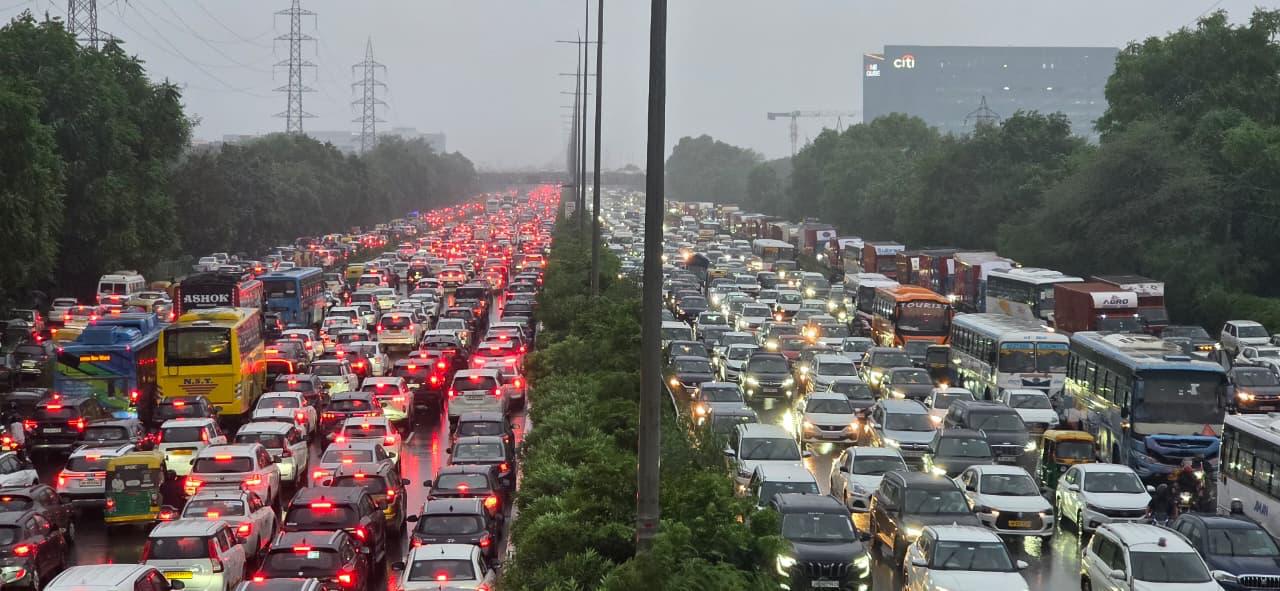
It is a familiar sight every year. A heavy downpour in Gurugram, and within minutes, MG Road looks like a shallow river. Cars stall at IFFCO Chowk underpass, water rises knee-high on Golf Course Road, and Cyber Hub commuters are left stranded as if the city itself has surrendered.
Authorities usually blame “unprecedented rainfall,” but the truth is harder to ignore. Gurugram is not drowning because of the clouds. It is drowning because of how it was built by erasing its natural drainage, laying roads where water once flowed, and allowing governance to dissolve into silos of confusion.
The Millennium City’s biggest failure is not in its glass towers but in forgetting the ground beneath them.
How Nature Once Drained Gurugram
Before real estate boards dotted the skyline, Gurugram was a landscape designed by nature to handle rain. At the foothills of the Aravallis, water flowed gently northward into the Najafgarh drain. Along the way, hundreds of ponds, wetlands, and shallow depressions acted like sponges, holding and filtering the monsoon’s excess.
Picture this, where Golf Course Road stands today, there used to be a large depression that naturally collected rainwater. In the rainy season, it turned into a seasonal pond. The water slowly percolated into the ground, replenishing aquifers. Residents could walk by and see buffaloes wading through marshy patches.
Fast forward to today. That same depression is now covered in tarmac and luxury real estate. Instead of soaking in rainwater, the ground repels it. The result? A short burst of rain is enough to submerge the very road that symbolizes Gurugram’s wealth.
From over 600 natural water bodies, less than half remain today. Many have been reduced to garbage dumps or paved over for construction. The city traded its natural drainage for square footage and now pays the price every monsoon.
Roads That Became Dams
If nature’s blueprint was ignored, infrastructure made things worse. Roads that should have been designed with water flow in mind became barriers instead.
Take MG Road. Built across low-lying terrain, it cuts straight through what was once a natural water channel. Instead of guiding water away, the road now traps it. That is why, every monsoon, the stretch between Sikanderpur and IFFCO Chowk resembles a reservoir more than a thoroughfare.
Or consider the Badshahpur drain once a vital artery for rainwater. Over the years, unchecked dumping and encroachment have choked it, reducing its capacity. What should have carried water away now pushes it back into neighbourhood like Sohna Road and Sector 56.
Even high-profile infrastructure projects, such as the Cyber Hub underpass and the Southern Peripheral Road, repeat the same mistakes. Built to move traffic faster, they ignored drainage. During monsoons, these engineering marvels act more like dams than escape routes.
Governance Paralysis
If geography was betrayed and infrastructure misdesigned, governance failed to correct course.
Multiple agencies GMDA, MCG, HSVP each control a piece of Gurugram’s drainage jigsaw. But instead of working together, they often pass blame. One agency widens a road without upgrading the drains beneath it. Another promises new pumping stations without clearing clogged channels. Budgets worth crores are announced for flood control, but results rarely reach the streets.
Officials rotate so quickly that few stay long enough to see a project through. Add political interference and the result is paralysis. Gurugram’s flooding is not an “act of God” but the outcome of poor coordination and absent leadership.
Why Gurugram Keeps Flooding: Lessons in Urban Chaos
To understand Gurugram’s waterlogging is to see a chain of cause and effect. Wetlands and ponds once absorbed water, but they were erased for housing and offices. Roads were built to showcase progress, but without drainage integration, they turned into barriers. The main drain that could have saved the city was clogged and encroached upon. And governance that could have coordinated a fix scattered into competing agencies.
The outcome is predictable. Every monsoon, the same images resurface: cars half-submerged near Cyber City, office workers wading through waist-high water, residents stuck for hours on Golf Course Road. Each photo is not just evidence of heavy rainfall but a reminder of choices ignored.
Can Gurugram Still Fix Itself?
The good news is that the solutions are not unknown. Other global cities have faced similar challenges and turned them around. Singapore, for instance, built an integrated drainage and water management system. Even Indian cities like Hyderabad have begun restoring tanks and lakes as flood buffers.
For Gurugram, the path forward lies in three priorities
Restore what remains of nature: The city must protect surviving ponds, wetlands, and drainage channels. Encroachment has to stop, and desilting must become regular practice.
Redesign infrastructure: with water in mind. Roads like MG Road and Golf Course Road need integrated drains that prevent them from acting as dams.
Unify governance: Flood management cannot be divided between GMDA, MCG, and HSVP without a central strategy and accountability.
These are not quick fixes, but without them, Gurugram will continue to choke every monsoon.
Conclusion: Reading the Water
Each year, when the rains flood Gurugram’s streets, it is not just an inconvenience. It is a message written in water. The ponds and wetlands buried beneath the city are resurfacing in the only way they can by reclaiming the roads built over them.
Golf Course Road flooding is not an accident. It is the memory of a vanished pond. MG Road’s waterlogging is not surprising. It is the ghost of a natural channel now trapped under tarmac. The Badshahpur drain’s overflow is not unexpected. It is the price of years of encroachment.
Gurugram does not flood because of rain. It floods because it forgot how to drain. And unless it learns to work with, rather than against, its geography, the Millennium City will keep sinking under its own neglect.
You always manage to raise the right questions! I hope the government learns to acknowledge the problem and spend the tax money now rather than waiting for Gurugram to become the next Punjab.